Thursday, April 19, 2012

What is good community design?


I do not intend for this blog to be nothing more than criticisms of everything wrong with design. I actually want to put some ideas out there that will create a better home, streetscape, neighborhood, community, and city. I am a community developer, an artist if you will, of the largest canvases there are. More than streets, homes, detention ponds, and parks, I design charm, nostalgia, energy, introspection, simplicity, and calm. I love the considerations held in esteem for New Urbanism, Transit Oriented Development, and Livable Centers, but I also am a strong beliver in the market system, supply and demand. The markets will determine much of what is the best use of a property, but only when the people get a varied choice. I beleive that when good design is an option, it will stand on their own because they are appealing, and maintain their value over production communities that are all too common.
The issue with being a community artist is that the canvas and tools for the art can cost quite a bit. I won't say it is expensive, because good design does not have to be expensive, but it does cost. Land, infrastructure, marketing, building materials, architects, engineers, hard and soft scapes. It requires a lot of capital investment, but expensive, no. That infers that it does not provide good value. Good design is a great value for so many reasons including having that timeless appeal.

Look at the websites for the following neighborhoods... they are some of my favorites

Prairie Crossing IL-- A FANTASTIC mix of a Transit Oriented Developement, public gathering spaces, classic and simple architecture, mixed with an farming theme. 


Serenbe, GA  a beautiful community where the urban and farm blend beautifully together...


Seabrook WA  An amazing neighborhood with thoughtful architecture, layout, and a selling price 200%+ higher than similar sized lots just up the road... tell me now that thoughtful design does not add value.  My friend Troy and I spend a fantastic afternoon touring this development and had enlightening conversation with the town founder Casey Roloff and his charming mom.


Seaside Fl  The town that was planned by the founders of New Urbanims Duany Plater-Zyberk is iconic for what it not only did to define seaside living, but also to the definition of what to expect of a neighborhood as a whole...


just a few neighborhoods that display a strong sense of design and that  i want to emulate in a future creation


the great east texas grass con

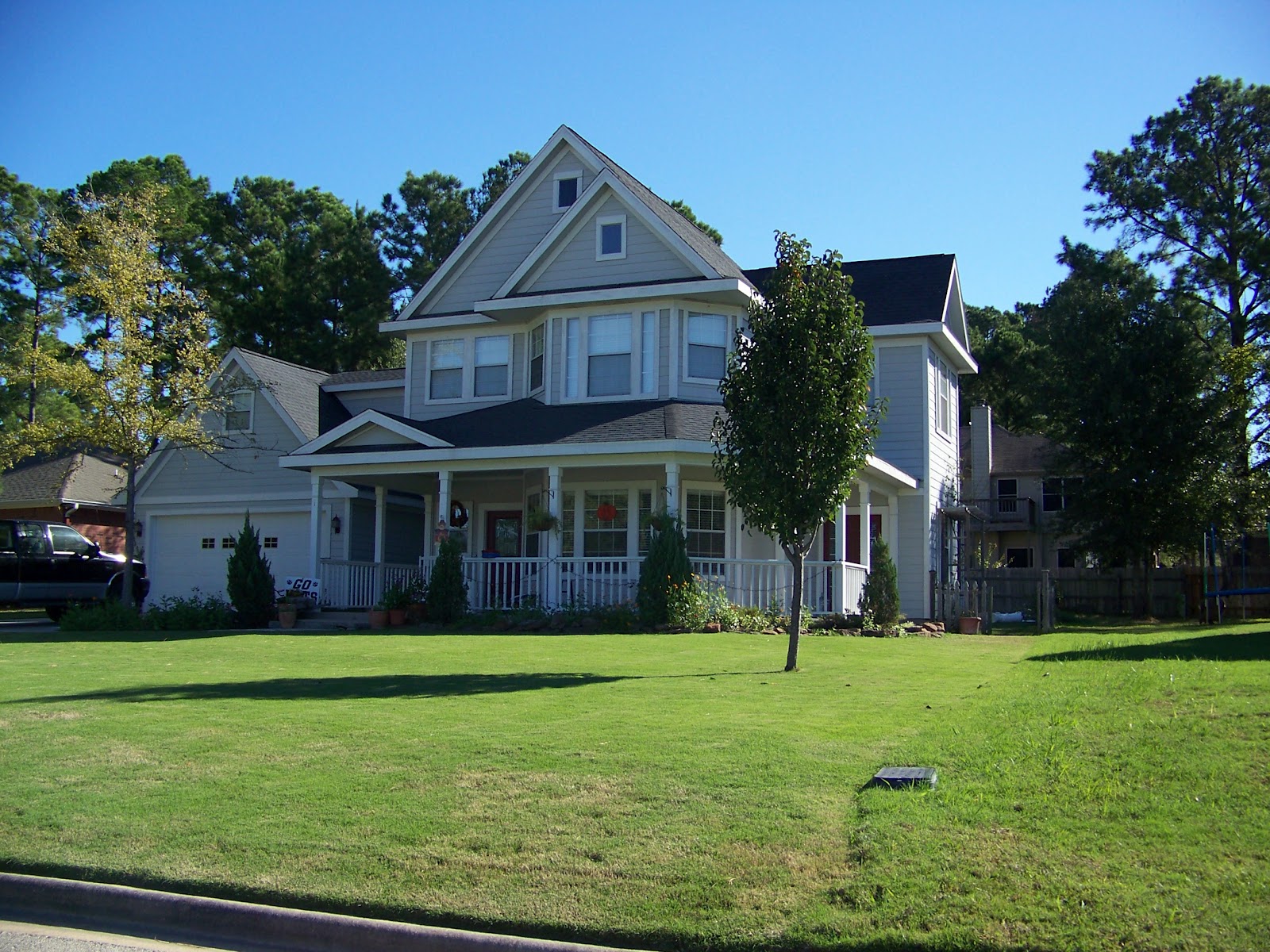
My current home and my bermuda grass
I live in Cypress Texas. The neighborhood I live in is not artistic and the homes are not charming. They are cheap. They are built well, fairly efficient, and I have fantastic neighbors, so I have much to be grateful for. But the homes are dull tract homes. Most of the homes in the surrounding neighborhoods- although more expensive and detailed, are still tract homes. Tract homes are generally the accepted norm here in Cypress. It is too bad. Tract homes leave much to be desired I will undoubtedly spend plenty of time on that soapbox in this blog.
When we moved in I attempted to beautify my home in a few ways, without putting so much into it that I knew I would never get back out. When we moved in I ripped out all of the St. Augustine grass from the front yard and put it into the backyard. I replaced it with bermuda grass. I am no agronomist, but bermuda is a grass that grows naturally here in Texas. When it grows from seed, or takes over after your st augustine dies when you don't water, it is much softer and looks like velvet when healthy and maintained. It is what is used on the roughs of most golf courses around here. In the picture you can see how soft my grass looks. I do not make that point to brag, because honestly, it is not like it is that much more expensive or takes any more TLC. I get weeds, sure, but most of them blow in from my neighbors who do not have bermuda. if they had bermuda also, the weed problems would be minimized. I believe that somtime around the early 1970s, a salesman came through east texas who was good. He was so good that he convinced hundreds, thousands, millions even, that soft, natural, local bermuda was a less desireable alternative than course, rough, scratchy st. augustine grass. What a genius. He was probably the cousin of the guy that convinced hundreds of homeowners in the Heights of Houston and other classic neighborhoods that vinyl and aluminum siding was truly the next big thing and would look fantastic on that vintage stately victorian or craftsman bungalow... yikes.

Monday, April 16, 2012

I am a land fantatic

I am a land fanatic.  I love thinking about it, staring at it, imagining what it could be, or absorbing what it has become.  I love thoughtfully developed land.  I love how some buildings, landscapes, communities and  towns have thoughtfully evolved as if they were a work of art.  Some by the hand of artists, others purely by the hand of a more enlightened power.  When a building or landscape makes you slow down, pause, inhale the atmosphere of what you're experiencing- almost as if you can remember it better by using your sense of smell, even if flora is not an element of the layout... that is what i am talking about... that is art. That is land used as a canvas.


I had my first taste into designing a community when we lived in a neighborhood by Lake Conroe. My job gave me enough time off that i could build and remodel part time.  My job also allowed me to travel all over the world and take specific notice of old cities and how they were laid out, their community and public spaces.  It was fascinating to look at the gathering plazas or piazzas in Europe, South America, and Mexico-- and how they were still, after hundreds of years, enormous draws to the population for socializing, commerce, and artistry.  It was at this point that i began to envision a role that I could play designing and eventually building these communities.  I began looking up the plats of undeveloped or underdeveloped pieces of land that caught my eye and designed prototype communities on paper for fun. I probably designed and redesigned hundreds of versions of land use layouts just for fun.
                                                  Our home by Lake Conroe

  I had a part in either building or designing 4 homes along the same street in that neighborhood within the same block.  Included was a home that we moved from before moving to Cypress.  I didnt have to rip out the grass though, since i was the builder, I put bermuda grass  in straight away when it was built.  This was a beautiful gently victorian home with soft grass, a cottage garden and a great view of the lake

My kids made about $20 that day from some generous
older kids in the neighborhood who thought they were cute.


This house did not cost much more to build than any other 2300 sq/ft home.  It had a big porch and a few other touches that added a bit of expense, but when it sold, it sold for well over $50k more than i had in it, and not because the surrounding area had increased in value.  This was a home that people would drive past ,hit the brakes, then slowly drive by and stare.  It was simple, charming and very different than the typical homes surrounding it.  Two more of the homes that I built on this block fed off the vintage craftsman style and sold at healthy margins as well.  Upon building these 3 homes that to a degree "played" off each other, I was sold.  I did not just want to build houses, I wanted to build designer communities.

The house I built next door to mine that
our good friends Jason and Tiffany moved
into with their great kids, Faith and Jonah.
Now mind you, by designer community, I do not mean "master-planned" community.  Houston is full of those.  Master planned seems to mean "lots of good amenities, but also lots of tract homes." I mean where every home is thought out, how the streets lay, and provide views to the natural elements of the surroundings- woods, meadows, water features.  How a home interacts with other homes, and interacts with the community.  Homes in such a community have to be "custom" homes.  They cannot be tract.  But this costs more.  This will not make as much money as production building.  At least not initially...

So after completing these homes, and building other individual homes in various communities around Lake Conroe, I decided to go back to school and get a Masters Degree.  There seemed to be various degrees that would enlighten me in how to generate and enhance this skill for building neighborhoods-- land development, planning, landscape architecture, etc.  I chose one that seemed to cover bits and pieces of the aforementioned degrees, but also studied community revitalization, economic development, and non profit development.  I initiated and obtained a masters degree in Community Development from Prairie View A&M University.

This experience at PVAMU is a story in itself-- generally a VERY positive experience.  Plus it led me to my first community development venture-- Peninsula 19

But at this point the purpose of this post has been met-- To define my background in anticipation of defining my ideas for what I want to create.